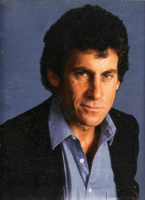
The Official Website of Paul Michael Glaser


"Our ability to love is our truest power, our greatest power as human beings." PMG

Updated:
July 2, 2007

Al Roker, CNBC, 1996

KAZAAM Premier

Francais Deutsch Espanol

AL ROKER: So what was it like working with someone who is not a trained, professional actor?

PAUL MICHAEL GLASER: The advantage is that you have somebody who's not tainted by the experience. You have somebody who's coming in with a tremendous amount of openness. And in Shaquille O'Neal's instance there's somebody who's coming in with a tremendous amount of talent. He's very talented. He has a tremendously personable quality about him. He has a big heart, he's a bit of a clown, he's a performer, he loves children. He's wonderful in this, he's going to surprise a lot of people in this film. And he came to this thing as a professional. And as a professional he said 'Ok, what do I gotta do?', and he learned. And he had his ears opened and his eyes opened and he rolled up his sleeves and he did it. And I'd like to think that in…no matter…in whatever you do in life if you're a professional you can apply that professionalism to anything else. And Shaquille did that and he did a remarkable job.

AR: So are we going to remember Shaquille O'Neal, when all is said and done, as a great basketball player or a great actor?

PMG: (laughs) I think you'll probably remember Shaquille O'Neal as a really wonderful person.

AR: Not bad. When did you make the decision 'You know, I like acting but I want to direct'? When was that…when did you…was it a conscious decision?

PMG: I think I always wanted to direct. My father was an architect, you know, and I always used to be fond of saying if my father hadn't been an architect I would have been one. (smiles) I was always intrigued by storytelling, by photography, by motion, by moving a camera. I was always intrigued by teaching. And so directing to me became an actual extension of things. I think acting is something I did as a sojourn into directing. When celebrity hit me I all of a sudden realized that celebrity wasn't the thing I wanted. What I wanted was to complete myself as an artist. And while I'll always be an actor, you don't - what is it? 'you can never take the actor out of the person'? or whatever - directing is something I really enjoy. It really fulfills me. I find it to be tremendously challenging.

AR: You know you said when celebrity hit you it wasn't what you thought. What did you think celebrity was going to be when you started out as an actor? What did you think it was going to be?

PMG: I don't think I ever really articulated it for myself. I think that component, and then the actor that wants attention, that wants approval, that wants to be recognized. He wants to be told that he's valuable and that he's good at what he does. That was functioning within me as well. I don't think I ever really at that point in my life - at whatever level of maturity I'd arrived at - I don't think I was able to focus on it or articulate it for myself. And I think when it happened I was kind of amazed that people were treating me that way for doing something that I didn't think was bad, but I didn't think it was worth all that adulation.

AR: When you got there, when you achieved your celebrity and you're at the height of your popularity, you're wondering, well…was it difficult for you because you knew you weren't maybe doing Shakespeare. You were doing a fun, kind of tongue in cheek action adventure program as opposed to performing the great works.

PMG: I think I probably would have liked to have been recognized for the actor I was trying to be. I didn't realize at the time that the actor I was trying to be was bringing a certain amount of technique and know-how and understanding to a persona that had been evolving in my performing for a while and manifested itself in Starsky.

AR: Was that something that…We'll talk about that when we come back, that and more when we continue with Paul Michael Glaser on the Al Roker program…

AR: Welcome back. You're on CNBC and we're talking to Paul Michael Glaser. And his movie Kazaam has a connection with a foundation that obviously has (to Paul) a closeness to you, The Pediatric Aids Foundation. (hesitates a moment)What's the connection there?

PMG: Well, when I look back at the film and the process by which it evolved or came to be or whatever, and what I was dealing with, it was very much about me finding my heart. It was very much about me, two months after Elizabeth died, finding a way to come to life, to express myself. And I looked at this story that was coming out of me and I looked at the way it was creating itself and what I was telling the story about. The story is about two people who are stuck together. They don't like each other at all but they can't help it because they're stuck together. It's the genie and the kid that has released him from his boom-box in this case not a lamp. And they have no choice but to figure a way to get along until the genie can get his three wishes and go back to where he wants to go. And in the course of this journey they find a friendship, a deep friendship. And they find a way to care for each other and they find their hearts. And in finding their hearts the genie finds his freedom and the boy finds his sense of self. And I looked upon this and I thought well that's really interesting because what the story talks about is the magic we all seek in this life, the power we all seek. We tend to seek it from without. We look for it in a genie or we look to a possession or we look to a process or we look to something we can buy or someone we can be with, someone we can be like. The power is really within our hearts, it's in ourselves. The magic is in our hearts. Our ability to love is our truest power, our greatest power as human beings. And I look at the work I've been doing since Elizabeth died. I've become chairman of the board of the foundation. An amazing organization that she put together with her two co-founders and it's done amazing work. It's realized - with a less than a 6% overhead, that means 94 cents out of every dollar goes into research - it has realized goals that are within reach now that we never thought possible. We are within the next 2 to 3 years capable of reducing transmission from maternal to infant of less than 2% in this country alone. That means in the next 5 to 10 years we can make that impact on the world. It's a pandemic in the world and this is something that's not on the front page anymore.

AR: Do you…why is it not out there? Why…

PMG: Well it's not out there because people don't want to have to deal with this everyday and because it's not newsworthy everyday. They get tired of it. And the economics of selling newspapers and selling magazines and selling programming is to give the public something new, something new, but the fact of the matter is it's still there - Now here's my point. We are on the verge at the foundation of making a tremendous impact. And what we're doing and what we're speaking to here is we're speaking to not only the need to find an answer or answers to Pediatric Aids and to HIV. We're speaking to the need to tell people and show people, by Elizabeth 's example and by the foundation and the work it does and by the way we all conduct ourselves, that we have the power to do it! The priority in our lives is to understand that if we can get in touch with that higher self. That higher love. That love, our ability, our empowerment, our magic. If we get in touch with that. If we make that a priority as something we really want to do and care to do, then we can make a difference. Not only in the world of Pediatric Aids. Not only in the world of all these issues of illnesses. But we can make a difference in terms of the way we conduct ourselves as human beings. And we can find ways to navigate and negotiate a more and more scary world. And the world is becoming that more and more.

AR: But in this…I mean, everything is about choice. I mean, your wife contracted Aids by way of a blood transfusion. You could have chosen, and you did for a while you kept it to yourselves, but then you went public with it. Was it a…When did you make the choice that this was something you were going to turn into a good thing or a positive thing at least as far as The Pediatric Aids Foundation? I mean, you had to make a choice, you and Elizabeth your wife.

PMG: I think that when you're confronted with tragedy, when you're confronted with loss, fear, your own fear, and this boils down to a fear of mortality whether it be your own mortality or a loved one's which only puts you more in touch with your fear of mortality. When we're confronted with that as humans we have a choice, you are right. Such a good 'choice' of words. We have a choice and that choice is to see ourselves as victims and say why me and get lost in our anger and lost in all the other feelings that grow out of fear. Or we can choose to say why not me and try to find the opportunity here. The opportunity to get in touch with our hearts, the opportunity to evolve, to become better, stronger, learn more, help more, do more as human beings. It's a basic choice. I'm very fortunate because on the one hand I had a wonderful teacher, teacher/therapist - a man who helped me understand an awful lot. I've had wonderful friends. I had a wonderful wife. I was blessed with a training and an education as a person from childhood that I guess, and I can not do more than guess, that enabled me when I came to that crossroad or that juncture in the road to understand that I had a choice. And the thing that I'm trying to communicate is that we all have that choice. We all have that choice. If we feel we have no choice then we are the victim. If we confront our mortality and all our feelings and go 'what can I do I have no choice', we have no choice. We've a victim. If we say 'I have a choice' then we have our dignity. We have integrity. We can say I'm making a choice and my choice is to find my compassion, to forgive myself for not being able to do more, to try to do as much as I can and to love myself and love my fellow man. That's a choice that I think we can make and that's so important today. The meditation that I live my life by and that is so much about what I've discovered in making this movie and the spirit of this movie is what I want so much to be able to share with people and that is the power is inside you, you have the power. You can do it. I'm sounding a little like an evangelist…

AR: But that's not a bad thing

PMG: No?

AR: No, that's not a bad thing. We'll continue this when we come back with Paul Michael Glaser.

AR: Welcome back on the Al Roker program, we're chatting with Paul Michael Glaser actor, director. How do you make the balance, because obviously The Pediatric Aids Foundation is something that's very close to you yet you have another life, you have a career. Is it difficult balancing?

PMG: Um, I think balance is something that is always difficult but it's what it's all about. So I don't focus on how difficult it is. I complain about it sometimes (laughs).

AR: Do you still have to deal with that? You know, worrying about your life. We look at people in entertainment and we think well they have these problems but they can't possibly be anything like ours. But sometimes they're worse and sometimes they're better…

PMG: You know that's one of the biggest ironies. One of the biggest ironies is that the degree to which we (indicates himself and Al) in the entertainment business are able to communicate with each other and then to the rest of the world is the degree by which we're successful. And what we're trying to communicate is that we're the same. We have the same problems the same difficulties the same everything. And I guess what you saying is that we have to overcome people's perception, or misconception, that because we get x amount of visible treatment, whether it be what people perceive as fame or attention and in some cases fortune, that that changes the landscape. It's ironic isn't it that we have this, I don't know if you call it a paradox, but we're trying to communicate one thing but we're perceived…and I'm saying that now and it sounds like an us vs. them and it isn't…

AR: But the media, and I'm saying (indicates himself) the media…we get treated to Entertainment Tonight or People Magazine or US and it creates almost a different world, that folks in Hollywood and New York live completely different lives…

PMG: You know you're touching on something that I think is really, really crucial and very important and that is what is the role of the media? What is the role of magazines, of television, of film? What is our function? Our function is to communicate. And what are we communicating? What we're trying to communicate, what we need to communicate, the reason we all get together in the same 'room', as it were, in the same place, we all get together to reaffirm our ability to overcome our fear. To reaffirm ourselves. To feel good about our humanity. To understand that everybody's in the same boat. That's the job and the responsibility of the media. However people's fears, people's greed get in the way and then the media is used to exploit. The media is used to exploit fear and misfortune, the difference between one group and another. And that's an unfortunate reality because then people start to lose…they start to lose their sight of what they are doing with this very powerful and valuable tool.

AR: Does the media have a right…if someone has a disease whether HIV or cancer or whatever. Does the media have a right to say so-and-so has…whether that person wants it known or not. Do they have the right to bring that out?

PMG: I wouldn't go there. What I would do is, I would……having been there, so I wouldn't presume to say we have the right because….…I think the more clear, the more important question is what's their responsibility with that information. All too often people like to say the responsibility of the media is to inform. That was the big thing in the 50's and 60's and 70's. When the question is tossed around they say the media is there to inform people and there was no responsibility taken whatsoever. They kind of adored a neutral concept, a neutral position. But the reality is there is a responsibility. Because we do have a printing press, we do have the ability to disseminate not only information but the experience of being people. We do have the responsibility of reaching people and letting them know they are not alone and we are not alone. We have a responsibility to underline togetherness. And as long as that's the case it's not so much whether they have a right to expose or not to expose. It's a question of what they do with the information, if they do it to exploit then they create division. If they use it to unite and inform and to underline and take responsibility for communicating the story of 'let's make this a better place' then that's something else.

AR: You talk about things being pushed to the back page and off the front page. What will it take for the media, journalism, whatever… to put the importance of this story, that HIV still deserves, back where it should be?

PMG: Well whether it's HIV or whether it's something else…you know something else will come down the block, the pike. There'll always be something. Mother nature will provide for that. The course of life on this planet will provide for that. We're fooling ourselves if we think otherwise. The value of researching HIV is an incredible fund of information to prepare us for the next thing. So we're foolish if we don't go in there and learn as much as we can and keep the pressure on and keep applying it. What will cause the press or the communication media to deal with this? You know, you'd like to think there is going to be some magic bullet that will make everyone go 'Oh! I get it!' we're going to be responsible and we're not going to let our greed and our avarice and fear and all these other things take over. But the reality is that man is constantly in a battle with his fear and on that he becomes very difficult to take responsibility. And there's so much on the table now, there's so much at stake for people. The world is getting smaller, money is more expensive, jobs are harder to come by, people that have them want to keep them, people that make all the money want to keep all the money. And so the media, which is a business, a business it's run to make money. It's motivation is not the betterment of humanity, it's motivation is to make money. So the question then becomes when is the point going to come when it serves us instead of using us? And I guess that point will come in time similar to the point in time that I was confronted with my issue.

AR: Well the fact is we don't make money on this program we just like helping people (laughs)

PMG: (smiling) well, I've experienced that and I appreciate it. I enjoyed talking to you.

(They shake hands)

AR: The movie Kazaam. Shaquille O'Neal. Paul Michael Glaser, producer and director. I'm Al Roker - we don't have a producer or director here. We just do the show and it shows up in your home, so appreciate what he does. (blows a kiss to the camera) Good night everybody!


Support EGPAF
About Elizabeth Glaser Pediatric AIDS Foundation

Auctions and Fundraiser's for EGPAF

Online CRAFTS FAIR! for EGPAF


Please use the SITEMAP for complete navigation of this site!

All contents copyright of PaulMichaelGlaser.org
All materials on this site are used for informational purposes only! This website is created only for the personal enjoyment of the fans of Paul Michael Glaser, the Internet public and anyone else interested in sharing the journey of Paul Michael Glaser. Photos and multimedia samples were taken from various sources like TV , Mags, newspapers, media interviews, etc . No copyright infringement is intended, nor are any profits being made from their use.

Speeches, Poetry and Notes are the personal property of Paul Michael Glaser, and paulmichaelglaser.org

They are NOT to be copied and posted on other sites or used in any other fashion.

Transcripts by Pam.

Linguist team: Raffaella, Hilly, Marion, Inma