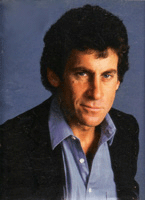
The Charles Grodin Show, CNBC, 1996 KAZAAM release
CHARLES GRODIN: Co-writer of a new film, “KAZAAM” starring Shaquille O’Neal which opens on Wednesday. So, you’re a producer, writer and director. Have you directed before?
PAUL MICHAEL GLASER: Yes, that’s my first film, my first film I get to say “I’m a real film-maker”.
CG: Why?
PAUL: Because I take it from conception and I wrote it, ah, I get a call from someone on the phone “do I know any good film roles for Shaquille O’Neal. I said, “this summer, No I don’t he should play a Genie and I hung up the phone. And I thought, well, that’s an interesting idea now and let’s see... what kind of Genie would I be interested in creating? So I created a Genie with a bad attitude, kinda tired, been in the machine for 5000 years tired of material wishes and lost his, ah, his idealism, a bit of a cynic and well, lets see, who can put him with? So I put him with a kid with an attitude who doesn’t believe in any magic, doesn’t believe in wishes or anything and these 2 unlikely characters are stuck with each other. A few other things, in a boom box, he’s a rapping Genie and it’s fun, it’s a nice piece that I was delighted to have happen. It happened 2 months after my wife died.
CG: The ideal film.
PAUL: The idea came up out of the blue. I stood there and went ‘Whoa”. Anything that made you humble about the creative process, you’re looking over here (turns to his right) and it comes out over there (turns to his left). You know that from your work.
CG: Yeah.
PAUL: It just happens and you go “whoa” and you just go wit it and it happens.
CG: Now, you were provoked by the phone call “Do you have any ideas for Shaquille O’Neal?”
PAUL: Yeah, but, in reality, I think that my whole journey with my daughter and my wife and the whole journey that I’ve been on and the lessons I was learning, the work I was doing and the, the, the growth that I was going through as a human being and think was what this genesis, that this person was all about.
CG: Umm hmm, you found, I’m sure that by jumping into the thing that the overwhelming demands of something like this would be the best possible thing…
PAUL: Absolutely, yeah.
CG: … that you can do. I’m sure that the tragic circumstances that you were doing…
PAUIL: Yeah. (Paul nodding in agreement)
CG… for people with even lesser... I always say do something, get yourself involved with certain things, don’t sit and think about it… don’t want to do that.
PAUL: Well, you know that when you have very little choice and I’m sure that you probably have found that yourself in your work and on your show now and talking with people, it’s a very real choice in our world now about whether you’re going to be a victim or whether your going to learn to take advantage of what’s happening to us and find, and find in our lives the opportunity to grow and by doing that, by just saying to be active, to choose to go ahead and go for it, you know, to choose to say “why me” but “why not me”, this is my life, this is an opportunity….
CG: Why me, it could be anybody, you know, whatever is happening to me, whatever happens, I don’t think “why me” because “why not me”. It happens to millions of people and, I mean, their just, just when you think you’ve heard everything, remember that story about the, ah, father that set his son on fire…
PAUL: umm hmm
CG: and then you’ve got Susan Smith...I mean their not HIV or AIDS, somebody just decides, for whatever reason, to go drown their children…
PAUL: Right.
CG: I mean,. it’s just what life holds, but I mean, you know, I’m, I think it’s so important what you’re doing that you took the blows that you’ve taken, losing your wife and your daughter…was what’s…. how old was your daughter?
PAUL: Ah, she was at the time, 7.
CG: So, she lived for seven years and she was ill for…
PAUL: For about 2 ½ years.
CG: 2 ½ years and your wife, how long was your wife,.. Did the symptoms of this, how long…
PAUL: Well, her real aggressive symptoms, her demise if you will, (coughs) lasted about (coughs), I guess you could say it was 2 phases, there was 2 years of ah, difficulty, really the last year was significant and painful. About AIDS, the thing is that it’s a long, prolonged journey. It’s not something that hits you and you’re down. No, she, she had, had quite a journey.
CG: Umm hmmm. I only have 30 seconds, how, your son, is how old?
PAUL: Ah, my son is 11; he’ll be 12 in October.
CG: And he has...
PAUL: He has HIV.
CG: What does that mean?
PAUL: Um hmm, well, today, that means, that means that ones viral load, ah, ah that he has about half his immune system. So, with the medicines that he has to take, he can sustain himself and he can have a very good life.
CG: We’ll go to a break and we’ll be right back with Paul Glaser.
(Back)(The very funny breakfast scene from KAZAAM is shown here)
CG: Did you ever play basketball?
PAUL: You know, I played in high school, not very good (laughs).
CG: Can you imagine, ah, playing basketball with this guy?
PAUL: (laughs) NO, no, no…
CG: You look at him on screen and say “oh I don’t want to play!”
PAUL: No, he’s a sweet, sweet boy, he’s big, he’s big!
CG: He’s a good performer too.
PAUL: You know, the camera really loves him, I mean, I had this idea and I had seen him in commercials, but I had, I had, then when I saw him in his reels, as it were, I couldn’t contain myself and then I met him. He’s surprisingly in this movie, I mean he plays a lot of levels that both of us appreciate, because we both act. He’s humorous, he’s a clown, he’s a performer, he loves the kids, he plays some beautiful moving moments, you know and he’s,..he’s delightful and the camera likes him, a lot!
CG: Umm, hmm.
CG: You said something at break, that we’re not trained in this society. How did you put it? The “empowerment of the journey to, ah, ah…
PAUL: Well, we we’re talking about mortality and talking about how difficult it is to deal with so many people. For all of us to deal with death, mortality and if you look at all the cultures, like eastern cultures, there’s a slightly different perspective on it and I think, it’s hopefully in our society. I hope that we’re going to reach a point where we learn that life’s a journey into death and that a negative or awful thing. If one deals with ones mortality or more specifically, one’s fear of mortality, one finds a great deal of strength, finds a great deal of empowerment. You have ...we find that we can choose to acknowledge ones fear, we choose to sit without fear and in doing so, we get more integrity, more self respect, we start to understand and to have more compassion for the fact, more compassion for ourselves, that we can not be doing anything about it and if we can get in touch with that, and choose to, because the choice is when we’re empowered. We choose to say, to acknowledge this, I choose to accept this compassion and we have compassion for our fellow man and when we have compassion for our fellow man, we have the ability to ,..being able to make this planet a more workable place, a better place, a more communicative place.
CG: Umm hmm, I give you... change your perspective on things.
PAUL: Yes, absolutely.
CG: Chance to understand, for what’s more important.
PAUL: It’s hard to understand what’s important. Its hard to understand your own fear, you understand the other guys fear and I think that’s such a, an important thing and our society where we’ve been trained so much to seek empowerment in concerns... what we own, what we do, what we build, what we do, how we’re seen, perceived and ah, based on approval , on peer approval, and, and, group acceptance and, ah, there is another journey to be had and you know, ah, I forget. I think it was... there is a book called, on, death and dying, I think it was that on, ah, on “He Who Dies”. On He Who Dies”, says the person who comes close to death, whether it be a relative that dies or themselves being mortally threatened, stands a change by that proximity of experience and stands a chance to be awakened to a journey of empowerment . That is extraordinarily valuable. You know, it’s very easy for a person who hasn’t had that to look at myself and say “Yes, of course, he has to do that. Look what he has lived through. Look what he has to rational in order to get along in his life, to get along in his day. And, ah, I have to say “yes, that maybe so, but I am extremely grateful for my journey.” I have gotten to places, learned things and evolved and developed as a human being to the sense that I don’t think I would have had I been in a life, you know, untouched by the circumstances. So as painful and difficult as it has been, and as much as I miss my daughter and my wife and as much as the sort of ____ in my neighborhood, if you will, I have learned and I have grown a lot and I am thankful for that.
CG: Do you believe in life after death?
PAUL: I, I don’t know if I believe in the literalness of a life after death, like “Hi Charles, good to see you. You had a good time down on the planet? You’re looking good for 200 years old!” (Laughs)
CG: Yeah and they let me keep this suit!
PAUL: Isn’t that nice, a nice contract! You know I don’t know if I believe in that specifically, but I know that what I believe and know and feel is that there is a consciousness, there is a, an existence in this universe, a mindfulness, a presence ah, ah, if you want to call it “God”, whatever anyone needs to call it, they should call it that and be comfortable with that. Best there is definitely a large experience that we are part of and that is a part of us and that we tap into that in the sense that we find a oneness with each other and the whole experience of life and death and life and death and life becomes a continual…
CG: We only have a minute and I wanna talk about the Pediatric AIDS Foundation that your wife and you have worked with so long.
PAUL: I have, ah, become Chairman of the board. We’re very active; it’s a very, very important time right now. Pediatric AIDS has gone to the back page or any AIDS, except in Vancouver convention, conference that we read about last week. This is an extremely important time, ah, because what HIV offers is an opportunity to study something that is only going to give more information to impact our understanding of other diseases and other situation that comes down the pike because nature is not finished. The world is diminishing in resources, it’s increasing in size, we’re living “tooth and jowl” with each other. Species are dying, viruses are losing their hosts. There is more coming down the pike, this is a journey into empowerment again. It’s very, very important to see the research that we need to do and we are on the verge of making a great impact, you know, we stand in the next 2 or 3 years to drop mother transmission down to 8 – 2% in this country. (Smiles)
CG: We have to go…
PAUL: I know.
CG… I’m so sorry, what a subject to end on. I’m so sorry, but one of the things we sure, we can take time to say is the medication should be more available to…
PAUL: Absolutely.
CG: … and lower in price for people. But we’ve run out of time. Thank you so much. You’re an inspiration.
PAUL: Well, thank you and thanks for having me.
CG: Thank you everybody. Good night mom, I love you!